
A Medical Milestone: First Pregnancy After Novel Microwave Ablation for Adenomyosis at Isha Womens Hospital
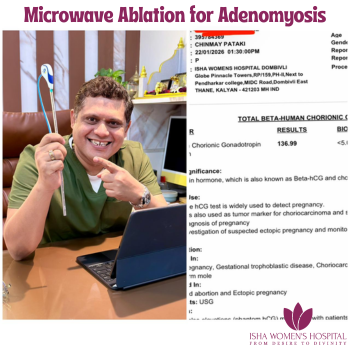
Moments like these define why advanced gynecological care matters.
We are extremely joyous and deeply proud to share a landmark achievement at Isha Women’s Hospital & IVF Centre, Dombivli — the first successful pregnancy following novel microwave ablation for adenomyosis at our centre.
This result is not just a positive pregnancy test.
It represents hope restored after years of pain, failed treatment, and fertility struggle — and it marks a major advancement in uterine-preserving treatment for adenomyosis.
Why This Achievement Is Significant
Adenomyosis is a challenging condition.
It causes severe pelvic pain, heavy bleeding, and infertility, and it often progresses despite conventional treatment.
What makes this case remarkable is that:
- The patient had already undergone an adenomyomectomy
- Despite surgery, the disease progressed
- She continued to suffer intolerable pain
- She also faced significant difficulty conceiving
In many such cases, women are told that pregnancy may not be possible or that hysterectomy may be the only solution.
This success proves otherwise.
About Adenomyosis – Why Treatment Is Difficult
Adenomyosis occurs when endometrial tissue grows into the muscular wall of the uterus.
Unlike fibroids, adenomyosis is diffuse and infiltrative, making it difficult to remove completely.
Challenges include:
- High recurrence after surgery
- Severe pain that does not respond to medicines
- Reduced implantation and fertility rates
- Limited uterus-preserving options
This is exactly where novel microwave ablation offers a breakthrough.
Introducing Novel Microwave Ablation for Adenomyosis
At Isha Women’s Hospital, we are proud to be:
- The first centre in the Thane district
- Among only a handful of centres in India
to offer novel microwave ablation for adenomyosis.
What Is Microwave Ablation?
Microwave ablation is a minimally invasive, uterus-preserving technique that uses targeted microwave energy to:
- Destroy adenomyotic tissue
- Reduce lesion size
- Relieve pain
- Preserve healthy uterine tissue
Unlike extensive surgical removal, this approach:
- Minimises trauma
- Reduces recurrence
- Improves fertility potential
The Case That Made History
In this particular case:
- The patient had a 6 cm adenomyoma
- She had failed a previous surgery
- Pain was severe, and the quality of life was poor
- Fertility was significantly compromised
Treatment Performed
A carefully planned, advanced approach was taken:
- Microwave ablation of the adenomyoma
- Simultaneous endometriosis surgery
This combined strategy addressed both pain and fertility-limiting factors.
The Fertility Journey After Ablation
After allowing time for uterine healing:
- Frozen embryo transfer (FET) was performed three months later
- The uterine environment showed favourable recovery
- Implantation was successful
And then came the moment that validates every effort —
A confirmed positive pregnancy
This marks the first reported pregnancy following novel microwave ablation for adenomyosis at our centre.
Why This Matters for Women With Adenomyosis
This success sends a powerful message:
- Adenomyosis does not automatically mean infertility
- Prior failed surgery does not mean the end of options
- Advanced, fertility-preserving treatment can change outcomes
- Individualised care matters more than one-size-fits-all surgery
For women who want pain relief without losing fertility, this represents a new horizon.
Isha Women’s Hospital – Advancing Fertility-Preserving Care
At Isha Women’s Hospital & IVF Centre, Dombivli, our approach is built on:
- Evidence-based innovation
- Advanced minimally invasive surgery
- Fertility-focused treatment planning
- Compassionate, patient-centred care
Introducing novel microwave ablation for adenomyosis reflects our commitment to offering world-class solutions locally, without forcing women to compromise between relief and motherhood.
A Moment of Pride, A Future of Possibility
This pregnancy is more than a clinical success.
It is a reminder that medical innovation changes lives.
For women suffering from adenomyosis — especially those told they have no options left — this milestone stands as proof that the right technology, expertise, and timing can make the impossible possible.
At Isha Women’s Hospital & IVF Centre, Dombivli, we remain committed to pushing boundaries responsibly, ethically, and always with the patient’s future in mind.
Frequently Asked Questions (FAQs)
Ans - This pregnancy is significant because adenomyosis is traditionally considered a fertility-challenging condition, especially in women who have already failed previous surgery.
In this case, the patient had undergone adenomyomectomy earlier, yet the disease progressed, pain worsened, and conception remained difficult. Achieving pregnancy after novel microwave ablation, combined with endometriosis surgery, demonstrates that uterus-preserving, minimally invasive treatments can restore fertility, even in complex and recurrent cases. It offers new hope to women who were previously told that options were limited.
2. How is microwave ablation different from conventional surgery for adenomyosis?
Ans - Conventional surgery for adenomyosis involves cutting and removing diseased uterine muscle, which can be technically difficult and carries a risk of recurrence and uterine scarring. Microwave ablation, on the other hand, uses targeted energy to destroy adenomyotic tissue from within, while preserving surrounding healthy uterine tissue.
This approach:
- Reduces surgical trauma
- Lowers recurrence risk
- Preserves uterine integrity
- Improves pain relief
- Creates a better environment for future pregnancy
3. Can women who have already failed adenomyosis surgery still benefit from microwave ablation?
Ans - Yes. This case clearly shows that prior surgical failure does not rule out future success. Even after adenomyomectomy and disease progression, microwave ablation was able to:
- Control pain
- Reduce the adenomyoma size
- Improve uterine conditions for implantation
4. Why was frozen embryo transfer (FET) done after microwave ablation?
Ans - After microwave ablation, the uterus needs time to heal and stabilise.
Waiting for three months allowed:
- Reduction of inflammation
- Improvement in uterine environment
- Optimal conditions for implantation
5. Who may be a suitable candidate for microwave ablation for adenomyosis?
Ans - Women who may benefit include those who:
- Have symptomatic adenomyosis with severe pain
- Wish to preserve their uterus and fertility
- Have failed medical therapy
- Have recurrent disease after surgery
- Have adenomyosis along with endometriosis