
Mosaic Embryo Result: Should We Transfer It, Freeze It, or Discard It
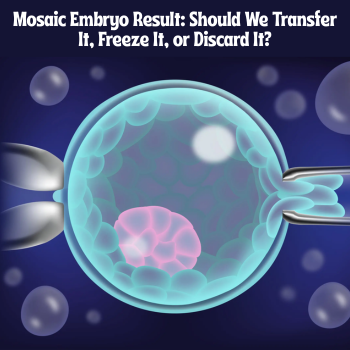
Receiving a PGT-A (Preimplantation Genetic Testing for Aneuploidy) report can be overwhelming, especially when the result says mosaic embryo.
Many couples immediately ask me:
Doctor, is this embryo healthy?
Should we transfer it?
Is it safer to discard it?
These are understandable questions because the word mosaic often creates uncertainty.
The good news is that a mosaic embryo is not automatically a bad embryo, nor is it automatically suitable for transfer. It represents a complex biological finding that requires careful interpretation.
During my practice as an IVF specialist, one of the most important parts of counseling couples is helping them understand that PGT-A results should never be interpreted in isolation. A mosaic embryo result must always be considered alongside the woman's age, embryo quality, fertility history, previous IVF outcomes, and family-building goals.
Current medical evidence shows that some carefully selected mosaic embryos have resulted in healthy pregnancies and live births, while others have a lower chance of implantation or may carry a higher risk of miscarriage. This is why every decision should be individualized rather than based on fear or assumptions.
In this guide, I'll explain what a mosaic embryo really means, why it happens, what current research tells us, and how fertility specialists help couples decide whether transferring, freezing, or not using a mosaic embryo is the most appropriate option.
Key Takeaways
- A mosaic embryo contains a mixture of chromosomally normal and abnormal cells identified during PGT-A testing.
- A mosaic result is different from a completely euploid (chromosomally normal) or aneuploid (chromosomally abnormal) embryo.
- Some mosaic embryos have resulted in healthy live births, but outcomes vary.
- The level and type of mosaicism are important when planning treatment.
- Decisions about transferring, freezing, or not using a mosaic embryo should always be individualized.
- Expert counseling from a fertility specialist—and, when appropriate, a genetic counselor—helps couples make informed decisions based on current evidence.
Understanding Mosaic Embryos
What Is a Mosaic Embryo?
One of the first things I explain to patients is that a mosaic embryo is neither completely normal nor completely abnormal.
Every embryo begins as a single fertilized egg that divides repeatedly into many cells.
Normally, every cell carries the same number of chromosomes.
However, during these early cell divisions, mistakes can occasionally occur.
When some cells remain chromosomally normal while others develop chromosomal abnormalities, the embryo is described as mosaic.
This finding is detected during Preimplantation Genetic Testing for Aneuploidy (PGT-A).
Unlike a euploid embryo, which appears chromosomally normal, or an aneuploid embryo, where abnormal chromosomes are detected in the tested sample, a mosaic embryo contains a mixture of both.
Dr. Chinmay Pataki explains:
A mosaic result doesn't automatically tell us whether an embryo can or cannot become a healthy pregnancy. It tells us that further interpretation is needed.
Understanding this distinction helps reduce unnecessary anxiety after receiving a PGT-A report.
How Does Mosaicism Develop?
Mosaicism usually develops after fertilization, during the early stages of embryo cell division.
As cells multiply, one or more divisions may occur with small chromosomal errors.
Importantly:
- These events usually happen randomly.
- They are rarely caused by anything the parents did.
- Lifestyle, exercise, travel, or routine daily activities do not cause embryo mosaicism.
Researchers continue studying why mosaic embryos develop and why some embryos appear capable of self-correcting while others do not.
Current evidence suggests that mosaicism is a naturally occurring biological phenomenon rather than a mistake made during IVF treatment.
This is why couples should never blame themselves after receiving a mosaic embryo report.
Understanding Your PGT-A Report
What Does a Mosaic Embryo Report Actually Tell You?
Receiving a PGT-A report filled with medical terminology can feel confusing.
Most reports classify embryos into one of three categories:
| PGT-A Result | Meaning |
|---|---|
| Euploid | Chromosomally normal embryo based on tested cells |
| Mosaic | Mixture of normal and abnormal cells detected |
| Aneuploid | Chromosomal abnormality identified in the tested sample |
One important point that many patients don't realize is that PGT-A examines only a small number of cells taken from the outer layer of the embryo (the trophectoderm).
The test does not evaluate every cell inside the embryo.
This means the laboratory report reflects the cells that were sampled—not necessarily the entire embryo.
That is why interpretation requires experience and careful clinical judgment.
Dr. Chinmay Pataki says:
PGT-A provides valuable information, but like every medical test, it has limitations. Results should always be interpreted alongside the complete clinical picture—not viewed in isolation.
Low-Level vs High-Level Mosaicism
Many laboratories further classify mosaic embryos based on the percentage of abnormal cells detected.
Although reporting methods vary between laboratories, results may be described as:
- Low-level mosaicism
- High-level mosaicism
Generally speaking, low-level mosaic embryos are often considered to have a more favorable prognosis than high-level mosaic embryos, although every case is unique.
The specific chromosome involved also influences decision-making.
Some chromosomal abnormalities may carry greater clinical significance than others.
This is why fertility specialists often review the complete laboratory report together with experienced embryologists and, when appropriate, genetic counselors before making recommendations.
No decision should be based solely on the word mosaic.
Should a Mosaic Embryo Be Transferred?
When Might a Mosaic Embryo Transfer Be Considered?
One of the most common questions I receive from couples after a PGT-A report is:
Doctor, if this embryo is mosaic, should we still transfer it?
There is no universal answer.
The decision to transfer a mosaic embryo is highly individualized and should be made after a detailed discussion with your fertility specialist. Current guidance from professional reproductive medicine societies recognizes that, in carefully selected situations, mosaic embryo transfer may be considered, particularly when no suitable euploid embryos are available.
Several factors influence this decision.
| Factor | Why It Matters |
|---|---|
| Availability of Euploid Embryos | Euploid embryos are generally prioritized for transfer when available. |
| Type of Mosaicism | The specific chromosome involved and the pattern of mosaicism affect clinical recommendations. |
| Low- vs High-Level Mosaicism | Lower levels of mosaicism may have a more favorable prognosis than higher levels, depending on the case. |
| Maternal Age | Age influences overall embryo availability and IVF treatment strategy. |
| Previous IVF History | Past IVF outcomes help guide future treatment decisions. |
| Family-Building Goals | Individual preferences and reproductive plans are an important part of shared decision-making. |
Published research has shown that some mosaic embryos have resulted in healthy pregnancies and live births.
However, implantation rates are generally lower than those seen with euploid embryos, and outcomes vary depending on the specific type of mosaicism.
This is why every case deserves careful review rather than a one-size-fits-all recommendation.
Dr. Chinmay Pataki explains:
A mosaic embryo transfer should never be viewed as a routine decision. Our role is to carefully evaluate the laboratory findings, review the latest evidence, and help couples understand both the potential benefits and limitations before moving forward.
Shared decision-making allows couples to choose the option that best aligns with their medical situation and personal values.
What Are the Potential Risks of Transferring a Mosaic Embryo?
When discussing mosaic embryo transfer, it's important to have an honest conversation about both the potential opportunities and the possible risks.
Compared with euploid embryos, mosaic embryos may have:
- Lower implantation rates.
- A higher chance of miscarriage in some cases.
- An increased possibility of abnormal pregnancy outcomes depending on the chromosome involved.
- Greater uncertainty regarding overall reproductive outcomes.
It is important to remember that not all mosaic embryos carry the same level of risk.
Factors such as the percentage of mosaic cells, the chromosomes involved, and the laboratory's reporting methods all contribute to clinical decision-making.
For this reason, fertility specialists avoid making recommendations based solely on the word mosaic.
Instead, the complete PGT-A report, embryo quality, patient history, and current medical evidence are considered together.
If pregnancy occurs after a mosaic embryo transfer, additional prenatal monitoring and diagnostic testing may be recommended to better understand fetal chromosome status.
Dr. Chinmay Pataki says:
Our responsibility is to provide clear, evidence-based information so couples understand both the possibilities and the uncertainties before making this important decision.
Should You Freeze or Discard a Mosaic Embryo?
Why Are Some Mosaic Embryos Frozen Instead of Immediately Transferred?
Receiving a mosaic embryo result does not always mean an immediate decision has to be made.
In many IVF programs, mosaic embryos are cryopreserved (frozen) while couples receive further counseling and review their available reproductive options.
Freezing allows valuable time for careful evaluation without compromising the embryo.
There are several reasons why a fertility specialist may recommend freezing a mosaic embryo.
| Reason | Explanation |
|---|---|
| Additional Counseling | Couples have time to understand the PGT-A findings and available options. |
| Future Family Planning | The embryo remains available if circumstances change later. |
| Euploid Embryos Available | Euploid embryos are generally transferred first, with mosaic embryos reserved for future consideration if appropriate. |
| Need for Further Review | Additional discussions with embryologists or genetic counselors may be helpful before making a decision. |
Freezing does not imply that the embryo will definitely be transferred in the future.
Instead, it preserves reproductive options while ensuring that important decisions are made thoughtfully rather than under pressure.
As research continues to evolve, recommendations regarding mosaic embryos may also become more refined, making careful long-term planning valuable for some couples.
Why Are Some Mosaic Embryos Not Recommended for Transfer?
Although some mosaic embryos may be considered for transfer, others may not be recommended.
This decision depends on several clinical factors rather than the presence of mosaicism alone.
For example, fertility specialists evaluate:
- Which chromosome is affected.
- Whether the mosaicism is low-level or high-level.
- Current scientific evidence regarding that specific chromosomal finding.
- The availability of euploid embryos.
- The couple's reproductive history and future goals.
Certain chromosomal abnormalities are associated with a greater likelihood of significant developmental or pregnancy-related complications.
In these situations, a fertility specialist may advise against transfer after carefully reviewing the available evidence.
Every recommendation should be individualized and discussed openly with the couple, ensuring they understand both the medical considerations and the available alternatives.
Dr. Chinmay Pataki explains:
Our goal is never simply to classify an embryo as 'good' or 'bad.' Instead, we evaluate the specific findings in the context of each couple's fertility journey and help them make an informed, personalized decision.
Additional Evaluation Before Making a Decision
The Role of Genetic Counseling
Receiving a mosaic embryo result can bring up many questions and emotions.
Couples often search online for answers, but the information they find may be confusing or even contradictory. This is why genetic counseling is an important part of the decision-making process when a mosaic embryo is being considered for transfer.
A genetic counselor works alongside your fertility specialist to help you understand what your PGT-A report means, explain its limitations, and discuss what is currently known—and not yet known—about mosaic embryos.
Rather than making decisions based on fear, couples receive balanced, evidence-based information tailored to their individual situation.
Important topics discussed during genetic counseling include:
| Discussion Topic | Why It's Important |
|---|---|
| Understanding the PGT-A Report | Explains the meaning of mosaicism and how the results should be interpreted. |
| Pregnancy Risks | Reviews available evidence regarding implantation, miscarriage, and pregnancy outcomes. |
| Alternative Treatment Options | Discusses whether other embryos or IVF strategies may be appropriate. |
| Prenatal Testing | Explains recommended screening and diagnostic tests if pregnancy occurs after transfer. |
| Family Planning Goals | Helps couples weigh medical information alongside their personal priorities and values. |
It's important to understand that genetic counseling is not about persuading couples toward a particular decision. Instead, it empowers them with accurate information so they can make choices that align with both current medical evidence and their own family-building goals.
Dr. Chinmay Pataki explains:
A mosaic embryo result often raises understandable concerns. Our responsibility is to explain what the science tells us today, acknowledge what remains uncertain, and support couples in making informed decisions without unnecessary fear.
Questions to Ask Your Fertility Specialist
Before deciding whether to transfer, freeze, or not use a mosaic embryo, I encourage every couple to ask questions and fully understand their options.
No question is too small when it comes to planning your future family.
Some helpful questions include:
- Is the mosaicism classified as low-level or high-level?
- Which chromosome or chromosomes are involved?
- Are there any euploid embryos available for transfer?
- How does my age affect this decision?
- What are the expected implantation and pregnancy rates in my situation?
- Would you recommend transferring this embryo based on current evidence?
- Should I meet with a genetic counselor before making a decision?
- If pregnancy occurs, what prenatal screening or diagnostic tests would be recommended?
- Would another IVF cycle provide additional reproductive options?
- How will this decision affect my long-term family planning?
Having an open discussion with your fertility team allows you to understand both the potential benefits and the limitations of every option.
Every decision should be made through shared decision-making, where medical expertise and patient preferences come together.
Pregnancy After Mosaic Embryo Transfer
Can Mosaic Embryos Result in Healthy Babies?
One of the most reassuring developments in reproductive medicine over the past decade is that healthy live births have been reported following the transfer of carefully selected mosaic embryos.
This has changed how fertility specialists approach mosaic embryo counseling.
Years ago, many mosaic embryos were not considered for transfer.
Today, accumulating clinical evidence suggests that selected mosaic embryos may still have reproductive potential, particularly when no euploid embryos are available.
However, it's equally important to understand that outcomes remain variable.
Possible outcomes after mosaic embryo transfer include:
| Possible Outcome | Notes |
|---|---|
| Healthy Live Birth | Reported in selected cases following careful evaluation and counseling. |
| Successful Implantation | Pregnancy may occur, but outcomes vary depending on the specific mosaic finding. |
| No Implantation | Some mosaic embryos do not implant despite transfer. |
| Miscarriage | Risk may be higher than with euploid embryos in certain situations. |
| Abnormal Pregnancy Outcome | Risk depends on the chromosome involved and the degree of mosaicism. |
Unfortunately, no fertility specialist can accurately predict the outcome of an individual mosaic embryo.
Every embryo behaves differently.
This is why recommendations are based on the best available scientific evidence, combined with each couple's medical history and treatment goals.
Dr. Chinmay Pataki says:
One of the most important messages I share with patients is that every mosaic embryo is unique. Decisions should be based on the specific laboratory findings and the individual couple—not on general assumptions.
Prenatal Testing After Pregnancy From a Mosaic Embryo
If pregnancy occurs following the transfer of a mosaic embryo, the journey does not end with a positive pregnancy test.
Careful prenatal monitoring becomes an important part of ongoing care.
Your fertility specialist and obstetrician will discuss the most appropriate testing plan based on your individual pregnancy.
This may include:
- Early pregnancy ultrasound.
- Routine first-trimester screening.
- Non-invasive prenatal screening (where appropriate).
- Diagnostic prenatal testing such as chorionic villus sampling (CVS) or amniocentesis, when clinically indicated and after appropriate counseling.
- Regular antenatal care throughout pregnancy.
It's important to understand that screening tests and diagnostic tests are different.
While screening estimates the chance of certain chromosomal conditions, diagnostic procedures provide more definitive information when indicated.
The decision to undergo prenatal testing is personal and should always be made after discussing the potential benefits, limitations, and risks with your healthcare team.
Careful follow-up ensures that both mother and baby receive the most appropriate care throughout pregnancy.
Personalized IVF Care at Isha Women's Hospital & IVF Centre
Individualized Embryo Review and Counseling
A mosaic embryo result is rarely straightforward.
At Isha Women's Hospital & IVF Centre, Dombivli, we believe that every embryo deserves an individualized assessment rather than a generalized recommendation.
No two fertility journeys are exactly alike, which is why treatment decisions are made only after carefully reviewing the complete clinical picture.
When a patient receives a mosaic embryo result, our team conducts a comprehensive evaluation that may include:
- A detailed review of the PGT-A report.
- Assessment of embryo grading and developmental stage.
- Evaluation of the specific chromosome(s) involved.
- Discussion of low-level versus high-level mosaicism.
- Review of previous IVF cycles and embryo outcomes.
- Assessment of maternal age, ovarian reserve, and reproductive history.
- Consideration of the couple's family-building goals.
Rather than focusing on a single laboratory result, we evaluate how every factor fits together.
This personalized approach helps couples understand not only what the report says but also what it means for their individual situation.
Dr. Chinmay Pataki explains:
Every mosaic embryo tells a different story. Our responsibility is to carefully interpret that story using current scientific evidence while considering each couple's unique reproductive journey.
We also encourage couples to ask questions and participate actively in the decision-making process, ensuring they feel informed and supported throughout their IVF journey.
Advanced IVF Care and Ongoing Fertility Support
Choosing whether to transfer, freeze, or not use a mosaic embryo is one of the most significant decisions many couples face during IVF treatment.
At Isha Women's Hospital & IVF Centre, our goal is to provide compassionate, evidence-based care that supports patients through every stage of that decision.
Our fertility services include:
- Comprehensive fertility evaluation.
- Individualized IVF treatment planning.
- Advanced embryo transfer strategies.
- Interpretation of PGT-A reports.
- Collaboration with genetic counselors when appropriate.
- Fertility preservation options.
- Personalized reproductive counseling.
- Continuous support before, during, and after IVF treatment.
We understand that receiving unexpected genetic testing results can be emotionally overwhelming.
Our team believes that clear communication, honest counseling, and shared decision-making help couples move forward with greater confidence.
Rather than offering one standard recommendation, we tailor treatment plans according to each patient's medical history, reproductive goals, and the latest available evidence.
Every Mosaic Embryo Deserves an Individual Assessment
Receiving a mosaic embryo result can feel unexpected and emotionally challenging.
Many couples assume the result automatically means the embryo cannot lead to a healthy pregnancy.
Fortunately, that is not always the case.
A mosaic embryo represents a complex biological finding rather than a simple yes-or-no answer.
Some carefully selected mosaic embryos have resulted in healthy live births, while others may have a lower chance of implantation or a higher risk of miscarriage.
The outcome depends on several factors, including the type of mosaicism, the chromosome involved, the degree of mosaicism, embryo quality, maternal age, and the couple's overall fertility history.
This is why treatment decisions should never be based on the laboratory report alone.
Instead, they should be guided by individualized clinical assessment, current scientific evidence, and thoughtful discussions between the couple and their fertility team.
At Isha Women's Hospital & IVF Centre, Dombivli, Dr. Chinmay Pataki and the fertility team are committed to helping couples understand their options with clarity, honesty, and compassion.
Whether the recommendation is to transfer, freeze, or not use a mosaic embryo, our focus remains the same—to provide personalized, evidence-based fertility care that supports informed decision-making and the best possible reproductive outcomes.
Dr. Chinmay Pataki
Consultant Fertility & IVF Specialist
Isha Women's Hospital & IVF Centre, Dombivli
A mosaic embryo result is not simply a 'yes' or 'no' decision. It requires careful interpretation, evidence-based guidance, and shared decision-making. Every couple deserves personalized counseling so they can move forward with confidence and realistic expectations.
Frequently Asked Questions (FAQs)
1. What is a mosaic embryo in IVF?
A mosaic embryo is an embryo that contains a mixture of chromosomally normal (euploid) and chromosomally abnormal (aneuploid) cells. Mosaicism is detected through Preimplantation Genetic Testing for Aneuploidy (PGT-A). A mosaic result does not automatically mean the embryo cannot lead to a healthy pregnancy, but it requires careful evaluation by a fertility specialist.
2. Can a mosaic embryo result in a healthy baby?
Yes. Studies have reported healthy live births after the transfer of carefully selected mosaic embryos. However, success depends on factors such as the type and level of mosaicism, the chromosome involved, embryo quality, and the overall fertility profile of the couple. Every case should be assessed individually.
3. Should all mosaic embryos be transferred?
No. Not every mosaic embryo is suitable for transfer. Fertility specialists consider factors such as the availability of euploid embryos, the degree of mosaicism, the chromosome involved, maternal age, and previous IVF history before recommending whether a mosaic embryo should be transferred.
4. Is a mosaic embryo the same as an abnormal embryo?
No. A mosaic embryo is different from a fully aneuploid embryo. While an aneuploid embryo has chromosomal abnormalities in the tested cells, a mosaic embryo contains a combination of normal and abnormal cells. This difference is important because some mosaic embryos may still have reproductive potential.
5. Should I freeze or discard a mosaic embryo?
There is no single answer for every couple. Some mosaic embryos are frozen to allow time for further counseling, future family planning, or because euploid embryos are transferred first. Others may not be recommended for transfer depending on the specific chromosomal findings. The decision should always be individualized.
6. What is the difference between low-level and high-level mosaic embryos?
Low-level mosaic embryos have a lower proportion of abnormal cells in the tested sample, while high-level mosaic embryos have a higher proportion. Although low-level mosaic embryos may have more favorable outcomes in some situations, treatment decisions depend on the complete PGT-A report and the specific chromosomes involved.
7. Do I need genetic counseling after receiving a mosaic embryo result?
Yes. Genetic counseling is generally recommended because it helps couples understand the PGT-A findings, the limitations of genetic testing, possible pregnancy outcomes, available treatment options, and recommended prenatal testing if pregnancy occurs. Counseling supports informed, evidence-based decision-making.
8. What prenatal tests are recommended after a mosaic embryo transfer?
If pregnancy occurs after transferring a mosaic embryo, your healthcare team may recommend routine first-trimester screening, detailed ultrasound examinations, and, when appropriate, diagnostic prenatal tests such as chorionic villus sampling (CVS) or amniocentesis. The choice of testing depends on your individual pregnancy and should be discussed with your fertility specialist and obstetrician.
9. Does a mosaic embryo have a lower success rate than a euploid embryo?
In general, euploid embryos have higher implantation and live birth rates than mosaic embryos. Mosaic embryos may have lower implantation rates and a higher risk of miscarriage in some cases. However, outcomes vary considerably depending on the type of mosaicism, and some mosaic embryos have resulted in healthy pregnancies.
10. When should I consult a fertility specialist about a mosaic embryo?
You should discuss your PGT-A report with an experienced fertility specialist as soon as you receive a mosaic embryo result. At Isha Women's Hospital & IVF Centre, Dombivli, Dr. Chinmay Pataki reviews the complete fertility history, embryo quality, PGT-A findings, and reproductive goals to help couples understand their options and develop a personalized treatment plan based on current medical evidence.