
Adenomyosis and Infertility: The Uterine Condition Often Confused With Fibroids
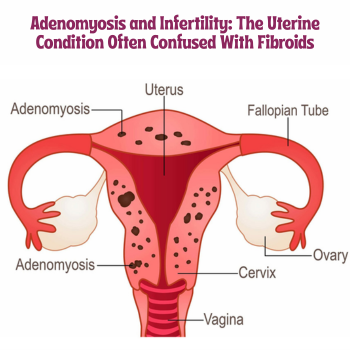
If you have heavy periods, severe cramps, pelvic pain, or difficulty conceiving, you may have been told that fibroids are the problem.
But there is another condition that can cause very similar symptoms: adenomyosis.
Adenomyosis affects the uterine muscle differently from fibroids, and understanding that difference can matter when pregnancy is your goal.
Key Takeaways
- Adenomyosis and fibroids are different conditions, even though both can cause heavy periods, pelvic pain, and an enlarged uterus.
- Adenomyosis occurs when tissue similar to the uterine lining grows into the muscular wall of the uterus.
- Some women have adenomyosis without obvious symptoms.
- Adenomyosis may be associated with difficulty conceiving, implantation problems, and increased miscarriage risk.
- Transvaginal ultrasound is often an important first investigation.
- MRI may provide additional information when the diagnosis or extent of disease is unclear.
- Treatment depends on symptoms, age, fertility goals, and the severity and location of adenomyosis.
- Women undergoing IVF with adenomyosis may need individualized treatment and timing.
- Adenomyosis does not automatically mean that IVF or surgery is necessary.
- Expert evaluation can help distinguish adenomyosis from fibroids and guide fertility-focused treatment.
Adenomyosis vs Fibroids
What Is Adenomyosis?
Adenomyosis occurs when tissue similar to the lining of the uterus grows within the muscular wall of the uterus.
This can cause the uterine muscle to become thicker and the uterus to become enlarged.
Some women experience significant symptoms, while others have very few or none.
Common symptoms can include:
- Heavy menstrual bleeding.
- Severe period pain.
- Pelvic pressure.
- Pain during intercourse.
- Chronic pelvic discomfort.
- An enlarged or tender uterus.
Adenomyosis is different from a fibroid.
A fibroid is a benign growth made up of uterine smooth muscle tissue, while adenomyosis involves endometrial-like tissue within the uterine muscle.
Adenomyosis affects the uterine muscle differently from fibroids, so identifying the condition correctly matters.
Why Adenomyosis Is Often Confused With Fibroids
The confusion is understandable.
Both conditions can cause heavy periods, painful periods, pelvic pressure, and an enlarged uterus.
They can also occur in the same woman.
| Adenomyosis | Fibroids |
|---|---|
| Endometrial-like tissue grows into uterine muscle | Benign growths of uterine smooth muscle |
| Often affects the uterus more diffusely | Usually forms distinct masses |
| May cause a uniformly enlarged uterus | May cause localized enlargement |
| Can cause significant menstrual pain | Symptoms vary according to size and location |
Imaging can sometimes help distinguish the two conditions.
However, adenomyosis can be focal or diffuse, and fibroids can vary considerably in appearance.
That is why the overall clinical picture matters.
Adenomyosis and fibroids are not interchangeable diagnoses.
Symptoms of Adenomyosis You Shouldn't Ignore
Severe Period Pain Is a Major Clue
Period cramps are common.
But pain deserves medical attention when it becomes severe, persistent, or progressively worse.
Watch for pain that:
- Interferes with work or daily activities.
- Requires frequent pain medication.
- Becomes worse over time.
- Continues outside menstruation.
- Occurs during sexual intercourse.
- Is accompanied by heavy menstrual bleeding.
These symptoms do not automatically mean adenomyosis.
Endometriosis, fibroids, pelvic inflammatory disease, and other conditions can cause similar symptoms.
Severe or worsening period pain should not simply be dismissed as a normal period.
Heavy or Prolonged Menstrual Bleeding
Adenomyosis can cause unusually heavy or prolonged periods.
Some women may also pass large blood clots.
Repeated heavy bleeding can eventually contribute to iron-deficiency anemia.
Possible symptoms of anemia include:
- Fatigue.
- Weakness.
- Dizziness.
- Shortness of breath.
- Reduced energy.
If your periods have suddenly become much heavier than they used to be, it is worth discussing the change with a gynecologist.
Heavy bleeding is a symptom worth investigating, even if pregnancy is not currently your goal.
Can Adenomyosis Exist Without Symptoms?
Yes.
Not every woman with adenomyosis experiences severe pain.
Some women discover the condition during an investigation for:
- Infertility.
- Heavy periods.
- Pelvic pain.
- Recurrent pregnancy loss.
- Abnormal ultrasound findings.
This is important because the absence of pain does not completely rule out adenomyosis.
Some cases are discovered only when a woman undergoes fertility or uterine evaluation.
How Adenomyosis May Affect Fertility
Can Adenomyosis Make It Harder to Conceive?
Adenomyosis may affect fertility through several possible mechanisms.
| Possible Effect | How It May Matter |
|---|---|
| Changes in uterine muscle | May affect embryo transport or implantation |
| Inflammation | Can alter the uterine environment |
| Abnormal uterine contractions | May interfere with implantation |
| Changes in the endometrium | May affect uterine receptivity |
The relationship between adenomyosis and infertility is complex.
Not every woman with adenomyosis will experience fertility problems.
Other factors also matter, including age, ovarian reserve, ovulation, fallopian tube health, sperm health, and the presence of endometriosis or fibroids.
Having adenomyosis does not mean pregnancy is impossible.
Adenomyosis and IVF: Why Implantation May Be Challenging
Some studies have associated adenomyosis with less favorable IVF outcomes in certain groups.
Possible concerns include:
- Reduced implantation.
- Lower clinical pregnancy rates in some populations.
- Increased miscarriage risk.
- Reduced live-birth rates in some IVF populations.
However, these outcomes are not identical for every patient.
The extent and location of adenomyosis may matter.
So can age, ovarian reserve, embryo quality, previous IVF history, and other reproductive conditions.
The presence of adenomyosis alone cannot tell you exactly what your IVF outcome will be.
How Is Adenomyosis Diagnosed?
Transvaginal Ultrasound: The First Important Test
A detailed transvaginal ultrasound is often an important first investigation when adenomyosis is suspected.
Depending on the case, the scan may look for features such as:
- Globular or enlarged uterus.
- Asymmetrical thickening of the uterine walls.
- Heterogeneous appearance of the myometrium.
- Small cystic spaces within the uterine muscle.
- Other characteristic ultrasound signs.
A specialist ultrasound can provide valuable information without requiring surgery.
However, ultrasound findings should always be interpreted alongside symptoms and medical history.
A good ultrasound assessment can provide important clues about adenomyosis and other uterine conditions.
When Is MRI Useful?
MRI may be considered when ultrasound findings are uncertain or when the doctor needs more information about disease extent.
It may be particularly useful when:
- The ultrasound diagnosis is unclear.
- The extent of adenomyosis needs clarification.
- Adenomyosis and fibroids occur together.
- Surgical planning is being considered.
| Ultrasound | MRI |
|---|---|
| Often used first | Useful in selected cases |
| Widely accessible | Provides more detailed imaging |
| Can identify characteristic features | Can help map disease extent |
| No radiation | No radiation |
MRI is not automatically necessary for every woman with suspected adenomyosis.
The decision depends on the clinical situation.
The right imaging test depends on what your doctor needs to know.
Adenomyosis vs Fibroids on Imaging and Adenomyosis & Recurrent Miscarriage
How Doctors Tell the Difference
The distinction between adenomyosis and fibroids can sometimes be challenging.
| Feature | Adenomyosis | Fibroid |
|---|---|---|
| Uterus | Often diffusely enlarged | May be enlarged because of discrete masses |
| Lesion | Often poorly defined | Usually well-defined |
| Muscle | Often heterogeneous | Distinct mass may be visible |
| Cysts | Small myometrial cysts may occur | Not typical |
| Distribution | Diffuse or focal | Usually localized |
Imaging findings are not always textbook.
A woman can also have both adenomyosis and fibroids.
This is why an experienced gynecological and fertility assessment can be valuable.
Correctly identifying the condition can influence the treatment strategy, especially when fertility is a priority.
Can You Have Both Adenomyosis and Fibroids?
Yes.
Adenomyosis and fibroids can occur together.
When both are present, symptoms may be more significant.
Treatment planning can also become more complex because the doctor needs to determine which condition is contributing to the symptoms or fertility concerns.
A complete assessment may therefore consider:
- Adenomyosis.
- Fibroids.
- Endometriosis.
- Endometrial polyps.
- Ovarian conditions.
- Uterine cavity abnormalities.
Finding one uterine condition does not mean other conditions should automatically be ruled out.
Does Adenomyosis Increase Miscarriage Risk?
Research suggests that adenomyosis may be associated with an increased risk of miscarriage, particularly in some IVF populations.
Possible contributing factors include:
- Inflammation.
- Abnormal uterine contractions.
- Changes in implantation.
- Alterations in the uterine environment.
However, adenomyosis is only one possible factor.
A miscarriage can have many causes, including chromosomal abnormalities, uterine abnormalities, endocrine disorders, and other medical conditions.
Therefore, recurrent pregnancy loss should not automatically be blamed on adenomyosis.
Adenomyosis may be part of the picture, but recurrent miscarriage needs a broader evaluation.
Adenomyosis Treatment When You Want Pregnancy
Treatment Depends on Your Fertility Goals
There is no single best treatment for adenomyosis for every woman.
Your doctor may consider your age, symptoms, ovarian reserve, disease severity, and whether you want pregnancy now or later.
| Goal | Possible Approach |
|---|---|
| Control symptoms without immediate pregnancy | Hormonal treatment may be considered |
| Trying naturally | Fertility assessment and individualized management |
| Planning IVF | Optimize treatment and timing |
| Severe localized disease | Surgical options may be discussed in selected cases |
A treatment that works well for controlling symptoms may not be appropriate when you are actively trying to conceive.
That is why your fertility plans should be part of the discussion from the beginning.
The right treatment is the one that fits both your medical condition and your reproductive goals.
Hormonal Treatment for Adenomyosis
Hormonal treatments can help manage symptoms such as:
- Heavy menstrual bleeding.
- Pelvic pain.
- Painful periods.
- Other disease-related symptoms.
Some hormonal treatments prevent pregnancy while they are being used.
That does not necessarily make them inappropriate.
They may be useful when pregnancy is not being attempted immediately.
But if you are actively trying to conceive, your doctor needs to coordinate symptom management with your fertility timeline.
Adenomyosis treatment should be planned around when you want to become pregnant.
Can Surgery Treat Adenomyosis?
Adenomyosis is different from a fibroid because it often does not form a clearly separated mass.
This means it cannot always be removed in the same way as a fibroid.
In selected women with focal adenomyosis, conservative surgery may be considered.
The decision can depend on:
- Location of disease.
- Extent of disease.
- Age.
- Fertility goals.
- Previous treatment.
- Other uterine conditions.
Conservative uterine surgery requires careful assessment because removing or modifying uterine muscle can have implications for a future pregnancy.
Surgery is not automatically the answer, especially when preserving fertility is important.
Adenomyosis and IVF Planning
Should Adenomyosis Be Treated Before IVF?
Not every woman with adenomyosis needs treatment before IVF.
A fertility specialist may consider:
- Age.
- Ovarian reserve.
- Adenomyosis severity.
- Symptoms.
- Previous IVF outcomes.
- Previous miscarriages.
- Presence of endometriosis.
- Presence of fibroids.
- Overall fertility history.
Some women may proceed directly toward fertility treatment.
Others may benefit from treatment before embryo transfer.
The decision should be individualized.
A diagnosis of adenomyosis does not automatically mean that IVF must be delayed or that pretreatment is mandatory.
Why IVF Timing Can Matter
In selected patients, doctors may consider treatment before embryo transfer.
The potential goals may include:
- Controlling disease activity.
- Optimizing the uterine environment.
- Preparing the endometrium appropriately.
- Coordinating treatment with the patient's reproductive goals.
Different pretreatment approaches have different levels of evidence.
Therefore, treatment should be based on the individual's circumstances rather than a fixed protocol for every patient.
When adenomyosis and IVF come together, timing can be as important as the treatment itself.
Lifestyle and Adenomyosis
Can Lifestyle Changes Cure Adenomyosis?
No.
Lifestyle changes cannot remove adenomyosis.
But healthy habits can support your overall health and help you manage some of the challenges associated with chronic gynecological conditions.
Useful habits include:
- Balanced nutrition.
- Regular physical activity.
- Maintaining a healthy weight.
- Adequate sleep.
- Stress management.
- Addressing iron deficiency when present.
Lifestyle changes should complement medical care rather than replace it.
Healthy habits support your health, but they are not a cure for adenomyosis.
Adenomyosis and Fertility Care at Isha Women's Hospital
Comprehensive Diagnosis and Fertility Assessment
At Isha Women's Hospital & IVF Centre, Dombivli, evaluation of suspected adenomyosis can take into account both symptoms and reproductive goals.
Depending on the individual case, assessment may include:
- Detailed menstrual history.
- Fertility history.
- Expert transvaginal ultrasound.
- MRI when clinically appropriate.
- Ovarian reserve assessment.
- Evaluation for fibroids.
- Assessment for endometriosis.
- Assessment of other uterine conditions.
The objective is to understand the complete reproductive picture before deciding on treatment.
This is particularly important when a woman is experiencing both adenomyosis and infertility.
The aim is to understand the whole patient, rather than treating an ultrasound finding in isolation.
Personalized Treatment and IVF Planning
Treatment may include different approaches depending on the woman's circumstances.
These may include:
- Medical symptom management.
- Fertility counseling.
- Conservative surgical evaluation in selected cases.
- IVF planning.
- Embryo transfer planning.
- Pregnancy monitoring.
Dr. Chinmay Pataki can help patients understand their fertility assessment and discuss treatment options according to their individual reproductive goals.
For women trying to conceive, the focus should not simply be on treating adenomyosis.
It should also be on understanding ovarian reserve, egg and sperm factors, uterine health, previous pregnancy history, and other factors that influence fertility.
Adenomyosis does not automatically mean you need IVF or surgery.
Adenomyosis Is Not Just Another Fibroid
Adenomyosis and fibroids can look similar because both may cause heavy periods, pelvic pain, and an enlarged uterus.
But they are different conditions.
That distinction matters when fertility is the goal.
Adenomyosis may be associated with difficulty conceiving, implantation problems, and miscarriage in some women.
At the same time, having adenomyosis does not mean that natural pregnancy or IVF success is impossible.
The right approach depends on your symptoms, age, ovarian reserve, fertility history, uterine findings, and reproductive plans.
If you have been told that you have fibroids but your symptoms do not quite fit, ask whether adenomyosis could also be part of the picture.
At Isha Women's Hospital & IVF Centre, Dombivli, a fertility-focused evaluation can help you understand what is happening and what options may be appropriate.
Adenomyosis should not be treated as just another fibroid. When fertility is important, the diagnosis, timing, and treatment plan all need to be considered together. — Dr. Chinmay Pataki